By topic
Spanish songs for learning the vowels and playing with sounds
In Spanish, the vowels always sound the same, which makes them a perfect toy for singing. This guide brings together three song games (swapping vowels, finding rhymes and clapping syllables) and what research says about them.
What playing with sounds means
Before they read, children learn to hear the parts inside words: syllables, like «sa-po» (“toad”); rhymes, like «tortuga» (“turtle”) and «lechuga» (“lettuce”); and single sounds, like the vowels. This is called phonological awareness, and songs are full of chances to practice it through play.
It’s linked to learning to read. A study that followed 64 English-speaking children from age 3 to 6 found that those who knew more nursery rhymes at 3 did better at reading and spelling over the next three years, and that the link ran through how well they heard the sounds in words. In Spanish, a study with 136 children aged 5 and 6 who couldn’t read yet found the same link between phonological awareness and reading.
That doesn’t mean a song teaches reading. An analysis of 13 studies found that music programs had a small effect on phonological awareness and no clear effect on reading fluency. Songs are a fun way to play with sounds, not a reading method.
In Spanish, start with syllables
That Spanish study found something more: noticing syllables played an important early part, both in the other levels of phonological awareness and in its first link with reading. So syllables are the place to start.
Clap once per syllable in words from the songs: «sa-po» (two claps), «la-gu-na» (“lagoon”, three), «a-pes-to-so» (“stinky”, four). Try everyone’s name, count the claps and find the longest word. In Colombia, the official learning goals for the year before first grade mention exactly these games: finding words that rhyme in music and circle games, and breaking words into parts with claps and foot stomps.
Once your child can clap one beat per syllable without help, move on to smaller sounds, like the vowels. That’s where the toad comes in.
The toad song: a vowel game
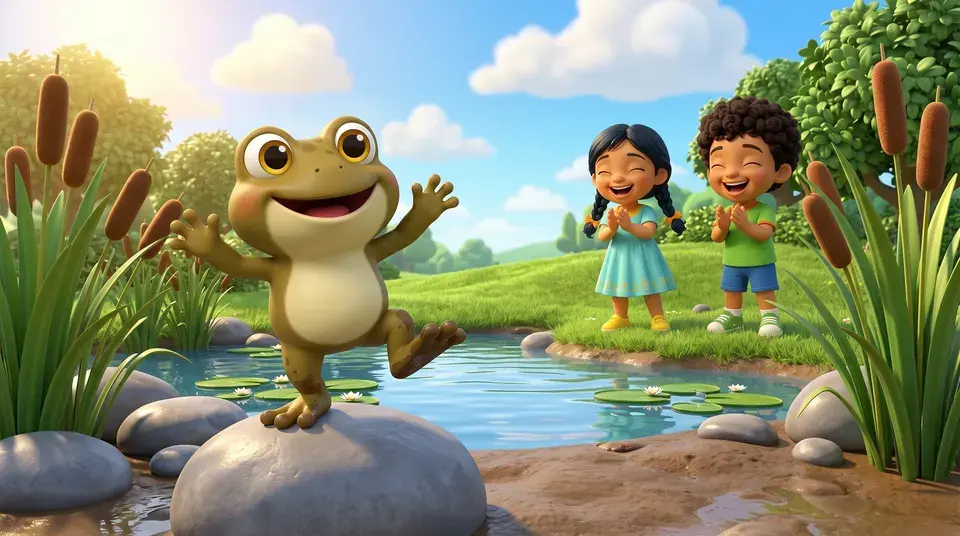
«El sapo no se lava el pie» (“The Toad Doesn’t Wash His Foot”) is sung normally first, then with every vowel swapped for a single one: with A, «Al sapa na sa lava al pa»; with U, «Ul supu nu su luvu ul pu». To swap each vowel, you have to hear it and say it inside the word: that’s playing with single sounds, one step beyond syllables. We didn’t find any study of this particular game, but it is a phonological awareness game, with vowels.
How to play: sing the normal version until everyone knows it. Before each round, ask «¿ahora con cuál vocal?» (“which vowel now?”) and let your child choose. If you don’t speak Spanish, the vowels sound like this: a (ah), e (eh), i (ee), o (oh), u (oo). Make big mouths and slow down in the swapped rounds. With 2- and 3-year-olds, try just the A; from 4 or 5, play a guessing game: you sing a line with one vowel without saying which, and your child works it out.
The site’s games section has «Las vocales del sapo» (“The toad’s vowels”): tap a vowel and the verse appears written with it. Use it for a moment to see how the song changes, then turn the screen off and sing it together.
Rhymes with the frog
In «Cucú, cucú, cantaba la rana» (“Cucú, Cucú, the Frog Was Singing”), every character rhymes with what they carry or do: «caballero» (“gentleman”) and «sombrero» (“hat”), «tortuga» and «lechuga», «pajarito» (“little bird”) and «bajito» (“softly”). Pause before the rhyming word, «con capa y…» (“with a cape and a…”), and let your child say «sombrero». Then ask whether «caballero» and «sombrero» sound the same at the end.
Other songs on the site rhyme too: «trigo» (“wheat”) and «abrigo» (“shelter”) in «Los pollitos dicen» (“The Little Chicks Say”), «cartón» (“cardboard”) and «jabón» (“soap”) in «Pin Pon es un muñeco» (“Pin Pon Is a Doll”), «cuartel» (“barracks”) and «coronel» (“colonel”) in «La farolera» (“The Lamplighter”). Make up new verses: «Cucú, cucú, pasó un…» (“Cucú, cucú, along came a…”) «ratón» (“mouse”)? What rhymes with it? Made-up words count too: what matters is hearing that they sound alike.
There’s no rush: in the CDC’s developmental milestones, using or recognizing simple rhymes shows up at age 5, among the things at least 3 in 4 children can do by then. Before that, just enjoy the game.
Pictograms and printed lyrics
The pictogram lyric sheets put a picture over each song’s key words, so children who don’t read yet, or who communicate with picture symbols, can follow along by pointing. They also work as clues for rhymes: on the «Los pollitos dicen» sheet, «trigo» and «abrigo» each have a picture, and on the «Pin Pon es un muñeco» sheet, so do «cartón» and «jabón». Point to them as you sing and ask whether they sound the same at the end.
With children who already know some letters, print a song from the songbook and look for every A, or every O, together; then sing the toad’s round with that vowel. It’s the same game, on paper.
Sources
- Bryant, P. E., Bradley, L., Maclean, M., & Crossland, J. (1989). Nursery rhymes, phonological skills and reading. Journal of Child Language. (opens external site)
- Jiménez, J. E., & Ortiz, M. R. (2000). Metalinguistic awareness and reading acquisition in the Spanish language. The Spanish Journal of Psychology. (opens external site)
- Gordon, R. L., Fehd, H. M., & McCandliss, B. D. (2015). Does music training enhance literacy skills? A meta-analysis. Frontiers in Psychology. (opens external site)
- Ministerio de Educación Nacional de Colombia (2016). Derechos Básicos de Aprendizaje: Transición. (opens external site)
- Zubler, J. M., Wiggins, L. D., Macias, M. M., et al. (2022). Evidence-informed milestones for developmental surveillance tools. Pediatrics. (opens external site)
More guides
 Spanish circle games and how to play themHow to play traditional Spanish circle games with kids: making the ring, taking turns, kind forfeits and including everyone, with steps for each game.
 Spanish songs with actionsSpanish action songs for kids: fingerplays and whole-body moves, how to make up actions together and how to adapt them for children who move less.
 Spanish counting songs for kidsSpanish counting songs for kids, with ideas for counting on fingers and with real objects, and what research says about how children learn numbers.