
By topic
Spanish counting songs for kids
Some songs count: one more elephant every verse, six weeks for a little boat, sums that go up by twos. This guide shows how to turn those numbers into real counting, on fingers and with objects, and what is known, and not known, about counting songs.
What we know, and what we don’t
We didn’t find any study that has tested counting songs as such. What they do is practice the numbers in order, «un, dos, tres, cuatro, cinco, seis» (“one, two, three, four, five, six”), which children need, but that isn’t the same as knowing how many. In a study with 3- and 4-year-olds, one through four were linked to amounts first; the bigger numbers followed about six months after children understood how counting works.
What is backed by research is counting things that are right there and talking about amounts every day. One study found that when parents counted or named how many things were in view, especially groups of 4 to 10, their children later had a better grasp of what each number means; other kinds of number talk didn’t show that link. In another, with 44 children, how much families talked about numbers between 14 and 30 months was linked to how well children understood numbers at almost 4. So the song is the excuse; the counting happens on fingers and with real things.
Count on fingers and with real things
Pair every song with something to touch: fingers, toys, blocks, spoons. Touch each thing once as you count it and, when you finish, repeat the last number: «uno, dos, tres… ¡tres elefantes!» (“one, two, three… three elephants!”). That last number tells you how many there are.
Add or take away one each verse and end with a question: «¿cuántos hay ahora?» (“how many are there now?”). If your child gets it wrong, count again together, with no rush to correct: even «La farolera» (“The Lamplighter”) sings «todas las cuentas me salieron mal» (“all my sums came out wrong”).
How to count with each song
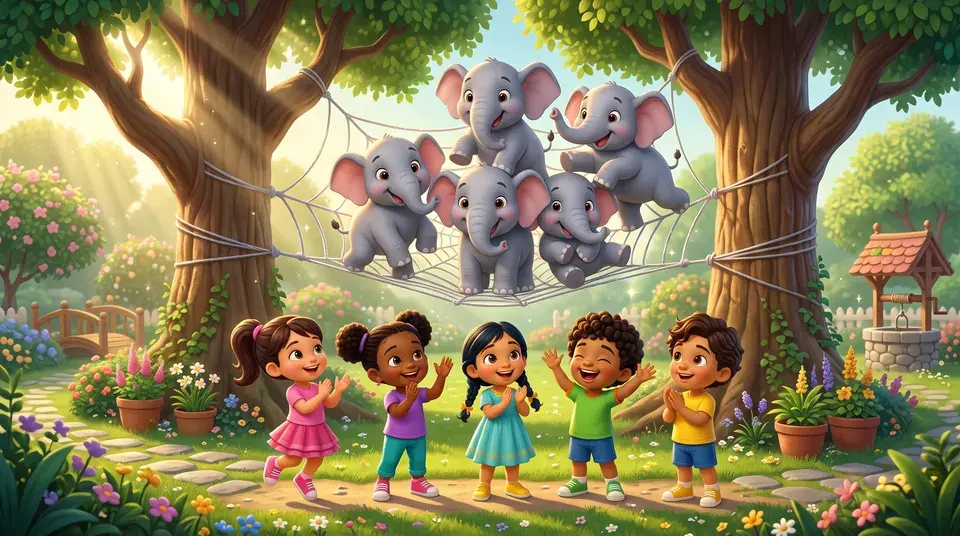
«Un elefante se balanceaba» (“One Elephant Was Balancing”) adds one elephant each verse, from one to six. Line up one more toy each time, or have each elephant invite someone into the line, and before each verse ask how many there are. At the end, count backward as everyone sits down: six, five, four…
In «El barquito chiquitico» (“The Teeny Tiny Boat”), the six weeks are counted on fingers, one at a time; pause before each number so your child can say it. Change how you count: with claps, little jumps or taps on your knees.
«La farolera» counts by twos, «dos y dos son cuatro, cuatro y dos son seis, seis y dos son ocho» (“two and two are four, four and two are six, six and two are eight”), then jumps by eights up to thirty-two. With 4- to 6-year-olds, count things that come in pairs, like shoes or socks, up to eight; clap through the rest of the sums, just for the fun of the song. For the youngest, «Canta y Brinca» (“Sing and Jump”) only counts to three before the jump.
Counting all day long
Beyond the songs, count what’s in front of you: the steps as you climb, the spoons on the table, the socks as you fold laundry. Groups of 4 to 10 things are good practice, because they’re too many to take in at a glance, so they have to be counted.
Number board games are another good idea. In a study with preschoolers from low-income families, 5 years old on average, playing a board game with the numbers in a row for about an hour went along with gains on four number tasks that were still there nine weeks later; children who played the same board with colors instead of numbers didn’t make those gains.
And no hurry: in the CDC’s developmental milestones, counting to 10 shows up at age 5, among the things at least 3 in 4 children can do by then.
Sources
- Le Corre, M., & Carey, S. (2007). One, two, three, four, nothing more: An investigation of the conceptual sources of the verbal counting principles. Cognition. (opens external site)
- Gunderson, E. A., & Levine, S. C. (2011). Some types of parent number talk count more than others: Relations between parents’ input and children’s cardinal-number knowledge. Developmental Science. (opens external site)
- Levine, S. C., Suriyakham, L. W., Rowe, M. L., Huttenlocher, J., & Gunderson, E. A. (2010). What counts in the development of young children’s number knowledge? Developmental Psychology. (opens external site)
- Ramani, G. B., & Siegler, R. S. (2008). Promoting broad and stable improvements in low-income children’s numerical knowledge through playing number board games. Child Development. (opens external site)
- Zubler, J. M., Wiggins, L. D., Macias, M. M., et al. (2022). Evidence-informed milestones for developmental surveillance tools. Pediatrics. (opens external site)
More guides
 Spanish circle games and how to play themHow to play traditional Spanish circle games with kids: making the ring, taking turns, kind forfeits and including everyone, with steps for each game.
 Spanish songs with actionsSpanish action songs for kids: fingerplays and whole-body moves, how to make up actions together and how to adapt them for children who move less.
 Spanish songs for learning the vowels and playing with soundsSong games for Spanish vowels, rhymes and syllables: how to play the toad’s vowel-swap song, and what research says about sounds and learning to read.