By topic
Spanish animal songs for kids
Frogs singing under the water, chicks who feel cold, elephants on a spider’s web: animal songs invite children to imitate, move and talk. This guide gathers ideas for making each animal’s sounds and moves, and for talking about how animals live and how we look after them.
How animals “talk” in Spanish
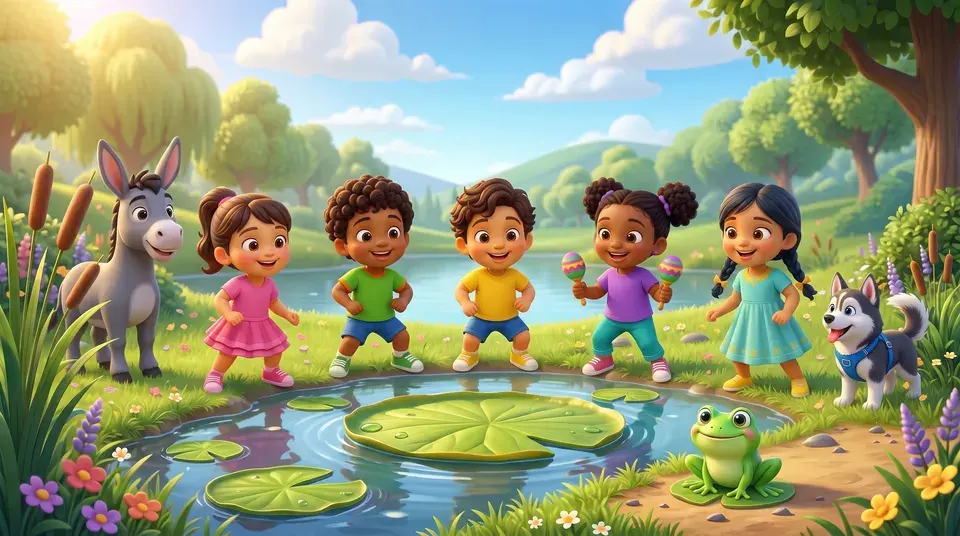
In Spanish, chicks say «pío, pío, pío» (“peep, peep, peep”), cats say «miau» (“meow”), dogs «guau» (“woof”), ducks «cuac» (“quack”), cows «mu» (“moo”) and roosters «quiquiriquí» (“cock-a-doodle-doo”). In «Cucú, cucú, cantaba la rana» (“Cucú, Cucú, the Frog Was Singing”), the frog sings «cucú»; when Spanish speakers imitate a real frog, they say «croac» (“ribbit”). Comparing animal sounds across languages is a game in itself.
Each sound can be a turn in a conversation: sing «Los pollitos dicen…» (“The little chicks say…”), wait, and let your child say «pío, pío, pío»; then ask «¿y cómo hace el perro?» (“and what does the dog say?”). That back-and-forth matters: in a study with 36 children aged 4 to 6, their conversational turns with adults were linked to their language more than the number of words they heard.
Preschool curricula include this too: in Chile, recognizing the sounds of animals and other everyday sources is a goal from the first level, toward age 2; in Colombia, the learning goals for the year before first grade ask children to link sound words, like «guau» or «pío», to what they stand for.
Moving like the animals
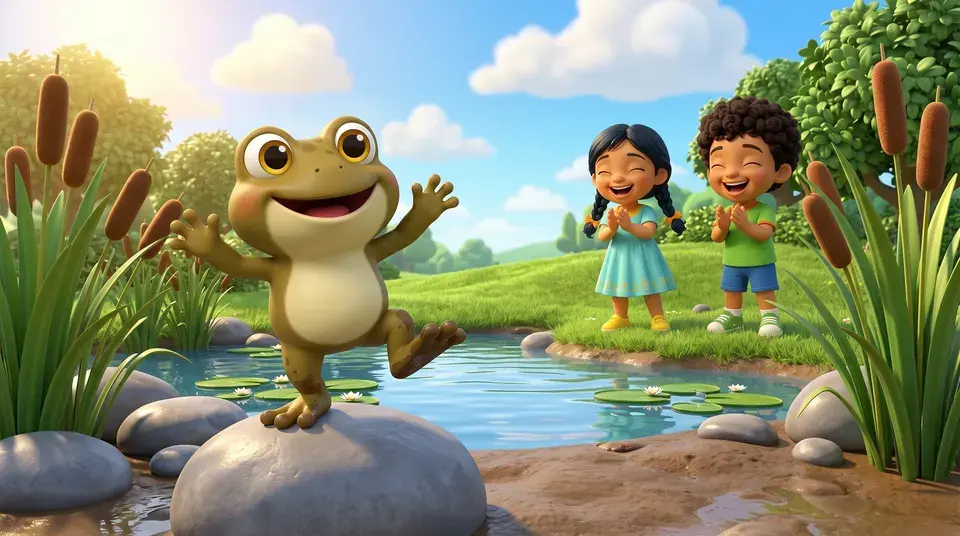
Each animal has its own way of moving: crouch and jump like frogs, walk slow and heavy like elephants with an arm for a trunk, huddle like chicks under the hen’s wings or flap like the painted bird. Play with opposites: fast and slow, heavy and light, loud and soft.
Pretending is part of play at this age: in the CDC’s developmental milestones, pretending to be something else during play, like a dog, shows up at age 4, among the things most children can do by then. Let your child choose an animal to act out and have everyone else guess which one it is.
How animals live and how we care for them
The songs are a great way into a conversation: where does the frog in the song live? «Debajo del agua» (“under the water”). And the toad? «Él vive en la laguna» (“he lives in the lagoon”). What does the hen do for her chicks? She feeds them and keeps them warm under her wings. Could a spider’s web hold an elephant? Welcome every idea, even the silliest.
Talk about how we care for animals too: what a pet or a farm animal needs, like water, food, a warm place and gentle hands, and who looks after them when they’re sick. With «A mi burro le duele la cabeza» (“My Donkey Has a Headache”), play at caring for the donkey with the song’s pretend remedies: real medicine, for people and for animals, is only ever given by a grown-up.
In «Sal de ahí, chivita» (“Get Out of There, Little Goat”) there’s a stick that won’t hit the wolf: in the game, the stick taps the floor gently and never touches anyone. Animals, like people, are treated with care, and before petting an animal that isn’t ours, we ask whoever looks after it.
Ideas by age
Ages 1 to 2: on your lap, with a stuffed animal, sing «Los pollitos dicen» and pause for the «pío». Ages 3 to 4: act out each character in «Cucú, cucú, cantaba la rana» and switch the animals in the songs: «los patitos dicen cuac, cuac, cuac» (“the little ducks say quack, quack, quack”). Ages 4 to 6: follow the order of the animals in «Sal de ahí, chivita», make up characters that rhyme and talk about real animals.
The «Lotería cantada», our picture-bingo game with songs, and the printable memory game use scenes from these songs: every time one with an animal comes up, everyone makes its sound.
Sources
- Romeo, R. R., et al. (2018). Beyond the 30-million-word gap: Children’s conversational exposure is associated with language-related brain function. Psychological Science. (opens external site)
- Zubler, J. M., Wiggins, L. D., Macias, M. M., et al. (2022). Evidence-informed milestones for developmental surveillance tools. Pediatrics. (opens external site)
- Subsecretaría de Educación Parvularia, Ministerio de Educación de Chile (2018). Bases Curriculares de la Educación Parvularia. (opens external site)
- Ministerio de Educación Nacional de Colombia (2016). Derechos Básicos de Aprendizaje: Transición. (opens external site)
More guides
 Spanish circle games and how to play themHow to play traditional Spanish circle games with kids: making the ring, taking turns, kind forfeits and including everyone, with steps for each game.
 Spanish songs with actionsSpanish action songs for kids: fingerplays and whole-body moves, how to make up actions together and how to adapt them for children who move less.
 Spanish songs for learning the vowels and playing with soundsSong games for Spanish vowels, rhymes and syllables: how to play the toad’s vowel-swap song, and what research says about sounds and learning to read.