
By age
Spanish songs for preschoolers (ages 3 to 6)
From ages 3 to 6, songs become games: circle games with turns, stop-and-go games, rhymes and songs that keep growing. This guide is for parents and teachers: what to sing, how to play it at home or in class, and what the research says, without the hype.
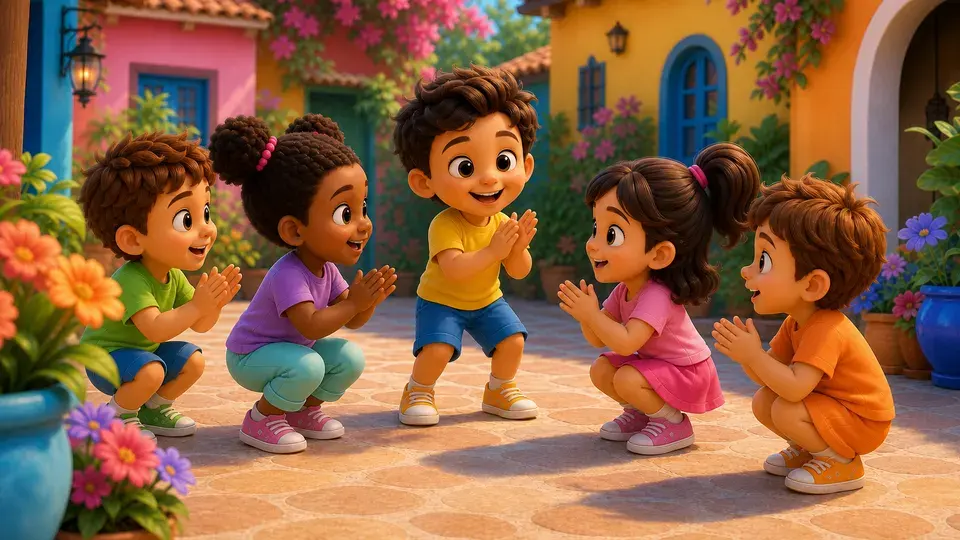
What singing looks like from 3 to 6
Among the CDC’s developmental milestones (from the US Centers for Disease Control and Prevention), at age 4: “Says some words from a song, story, or nursery rhyme” and “Pretends to be something else during play.” At 5: “Sings, dances, or acts for you” and “Follows rules or takes turns when playing games with other children.”
Also at 5: “Uses or recognizes simple rhymes (bat-cat, ball-tall),” “Counts to 10” and “Pays attention for 5 to 10 minutes during activities.” Each milestone is something at least 3 in 4 children do by that age, not an average or a test. If anything worries you, talk to your child’s doctor.
In music, all of that shows: children this age can handle longer songs, rules, roles and word games. It’s the age of circle games.
How to sing with them, at home or in class
At home, the usual: face to face, slowly, with actions and a pause before a word so your child can fill it in. With a group, sing it as an echo, line by line: you sing a line and the group sings it back. And use the same short song for the same routine, like tidying up or saying goodbye, so children know what comes next.
Let children lead. At age 4, the CDC suggests: “Play your child’s favorite songs and dance with your child. Take turns copying each other’s moves.” In a circle game, that means letting a child choose the action, the vowel or who goes next. Try the opposites games the CDC suggests at age 3, too, like fast and slow or quiet and loud: the same song, sung a different way.
Watch the video once, together, as a model, then turn the screen off: the song is played without it. Not a Spanish speaker? Each song in this guide has, on its page, the English meaning under every line and a “How to say it” box for the key words.
Rule games and taking turns
Circle games and stop-and-go games practice three things: listening, waiting for the signal and switching rules. Make them harder little by little: in «El patio de mi casa» (“The Patio at My House”), everyone crouches on «agáchate» (“crouch down”); next, a child leads and calls it out; with 5- and 6-year-olds, play it backwards, so on «agáchate» everyone stretches up tall. In «Antón Pirulero», a traditional rule game, the challenge is noticing in time when the leader copies your job, and switching to theirs.
Keep everyone in the game. A child who slips up doesn’t sit out: they pay a funny forfeit, like making an animal sound, or lead the next round. Forfeits are optional and never meant to embarrass. With 3-year-olds, play «Antón Pirulero» without forfeits: everyone copies the leader and switches together when you call «¡cambio!» (“switch!”).
And the research? A review of 90 studies with 8,925 children found that skills like waiting, keeping a rule in mind and switching it (known as executive functions) can be fostered; that playful, enjoyable approaches work as well as formal drills; and that there’s no convincing evidence the effects last. So play these games for what they are: a good time together, again and again.
Rhymes, syllables and sounds
Rhyming and sound-swapping games practice hearing the sounds inside words, a skill linked to learning to read. A study that followed 64 children from age 3 to 6 found that those who knew more nursery rhymes at 3 read and spelled better three years later, even after taking IQ and social background into account. It’s a link, not proof that rhymes are the cause.
In Spanish, syllables come first: a study with 136 Spanish-speaking 5- and 6-year-olds who couldn’t read yet found that syllable awareness played a key early role as they began to notice the other sounds in words. Clap once per syllable: «sa-po» (“toad”), «ra-na» (“frog”), «e-le-fan-te» (“elephant”).
With the songs on this site: in «Cucú, cucú, cantaba la rana» (“Cucú, Cucú, the Frog Was Singing”), pause before the rhyming word, like «sombrero» (“hat”) or «lechuga» (“lettuce”), and make up new characters that rhyme. In «El sapo no se lava el pie» (“The Toad Doesn’t Wash His Foot”), swap every vowel for just one: «Al sapa na sa lava al pa». We know of no study of this particular game, but it’s the same kind of sound play. And at 5, the CDC suggests rhyming games: “What rhymes with cat?”
Screens from 3 to 6
The World Health Organization (WHO) guidelines for children under 5 say that at ages 3 and 4, “Sedentary screen time should be no more than 1 hour; less is better.” They also recommend at least 180 minutes a day of varied physical activity, including at least 60 minutes of moderate-to-vigorous activity. A circle game or a jumping song counts.
A meta-analysis of studies with children from birth to 6 found that they learn less from a video than from a person in front of them, and that the gap shrinks as they grow. That’s why, on this site, the video is the model: watch it once, together, then sing and play the song with the screen off. Those WHO guidelines stop at age 4; with 5- and 6-year-olds, we follow the same idea.
Sources
- Centers for Disease Control and Prevention. Developmental milestones, revised 2022 (Learn the Signs. Act Early.). (opens external site)
- World Health Organization (2019). Guidelines on physical activity, sedentary behaviour and sleep for children under 5 years of age. (opens external site)
- Bryant, P. E., et al. (1989). Nursery rhymes, phonological skills and reading. Journal of Child Language. (opens external site)
- Jiménez, J. E., & Ortiz, M. R. (2000). Metalinguistic awareness and reading acquisition in the Spanish language. The Spanish Journal of Psychology. (opens external site)
- Takacs, Z. K., & Kassai, R. (2019). The efficacy of different interventions to foster children’s executive function skills: A series of meta-analyses. Psychological Bulletin. (opens external site)
- Strouse, G. A., & Samson, J. E. (2021). Learning from video: A meta-analysis of the video deficit in children ages 0 to 6 years. Child Development. (opens external site)
More guides
 Spanish songs for babies: singing to your baby from birth to 12 monthsSpanish songs for babies from birth to 12 months: which songs to sing, how to sing face to face, what research shows and the WHO’s advice on screens.
 Spanish songs for toddlers (ages 1 to 3)Spanish songs for toddlers ages 1 to 3: which songs to sing, how to use actions, pauses and routines, and what the WHO advises on screens.
 Spanish circle games and how to play themHow to play traditional Spanish circle games with kids: making the ring, taking turns, kind forfeits and including everyone, with steps for each game.